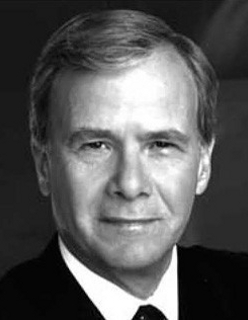
Tom Brokaw
Full Name: Thomas John Brokaw
Birthdate: February 6, 1940
Birthplace: Webster, South Dakota, USA
Occupation: Author and Television Journalist
Profile: Best known for
The Greatest Generation and as anchor of
NBC Nightly News (1982-2004).
Website: http://en.wikipedia.org/wiki/Tom_Brokaw
Number of Quotes: 145
'1920 was an auspicious year for a young person to enter the world as an American citizen.
A nation that forgets its past has no future.
ABC wouldn't be a player in the news major leagues until the 1970s, when Roone Arledge
brought to ABC News the energy and programming approach he had applied to ABC Sports.
After 50 years of smoking unfiltered cigarettes, my father died, too young, of a massive heart attack. He was 69.
It's almost certain that all those years of nicotine inhalation were a major contributor to his clogged arteries.
Americans are generous and open-hearted people.
As young parents of three girls, living in California during the late Sixties and early Seventies, Meredith and I couldn't help but be aware of the rising level
of dialogue, debate, commentary, and proclamations about the place of women in society and about how to raise females in light of this raised consciousness.
Barack Obama's name will be
the one on the peace prize, but his speech and his manner could become a gift for generations to come.
Baseball is a human endeavor, not a statistical science, and the human factor is both its glory and its despair.
Because I lived in construction towns, we had a lot of workers who came from the
South. They were all white, and, sorry to say, a number of them were pretty redneck.
Cable penetrates 70 percent of American audiences now.
Cancer has given me a dose of humility. I'm much more empathetic. It's a club I would rather not have joined, but it is a club.
Courage is not the absence of fear, but the judgment that something else is more important than fear.
David Brinkley was an icon of modern broadcast journalism, a brilliant writer who could say
in a few words what the country needed to hear during times of crisis, tragedy and triumph.
Don't overstate Fox News. It's still much smaller than the least of the network niches.
During World War II, law-abiding Japanese-American citizens were herded into remote internment camps, losing
their jobs, businesses and social standing, while an all-Japanese-American division fought heroically in Europe.
Everywhere I go - from Main Street to Wall Street - people ask, What's happened to our political system? Why can't Washington folks work together?
Gerald Ford brought to the political arena no demons, no hidden agenda, no hit list or acts
of vengeance. He knew who he was, and he didn't require consultants or gurus to change him.
Geraldine Ferraro, the first woman to run for vice president, died from multiple myeloma. Frank Reynolds, the ABC anchorman, who I had talked to
toward the end of his life, not knowing what he had, died from it. Later I found out that Frank McGee, who was the Today Show host, died from it.
Google is not a synonym for research.
Here is a secret that no one has told you: Real life is junior high.
Heroes are people who rise to the occasion and slip quietly away.
I am simply the most conspicuous part of a large, thoroughly dedicated and professional staff that extends from just behind these cameras,
across this country and around the world, in too many instances, in places of grave danger and personal hardship. They're family to me.
I believe you make your own luck. My motto is It's always a mistake not to go.
I don't like to play the macho card, but I grew up in a working-class family and a working-class culture.
I guess the issue that I have with all the news organizations that have a political MO, if you will,
attached to them is that they sometimes jump to conclusions about what this will mean. Get ahead of themselves.
I had always been interested in race and racial justice, but mostly it was with my
nose pressed up against the glass, looking at the South from a long way away.
I had four compression fractures in my spine. They were repaired, but it cost me two inches of height.
I had fractures in my spine that had to be repaired that came as a big surprise; nobody warned me that I
might get some really severe, threatening fractures. It was painful, and I lost two inches of height, bang!
I had gone to all the big stories of the '80s, which was one of the most fertile times in American journalism, around the world and here as well.
I had good care going. I had Meredith and the family. And I didn't want to become the object of some
kind of pity, most of all. I didn't want to show up on the Internet, Tom Brokaw has cancer.
I had this unusual mix of curiosity, the ability to write in ways people understood, and
when I appeared, viewers seemed to trust me to get them through some cataclysmic changes.
I have no problem whatsoever with a kind of political overview or an ideological overview for any of these outlets as long as it's
transparent. We know where Breitbart stands, we know where Fox stands, where MSNBC stands. So, people go in with an understanding of that.
I played high school basketball at six feet, then I went to 5-11 in my 50's, and then, bang, I went down to 5-9.
I started writing a journal, and I was learning so much along the way. How to deal with your family, how to deal with your friends.
I think obviously we need to work harder at extending the women's movement. How do women who have
prepared for careers and have a child get back to the workplace and still fulfill maternal roles?
I think people of my generation became journalists — you know, right after the broadcast pioneer fathers — because we wanted to report the big stories.
I think they are paying a lot more attention to news now, by the way, in part because of
national-security issues. A lot of young people have friends or family in the military today.
I was a college dropout, hitchhiking across the Midwest. That was part of the old, adventurous spirit.
I was a young man working in Omaha, Nebraska, in the mid-1960s when I received a call, and I was
summoned to Atlanta to work at WSB. It was, for me, the beginning of a real education about the South.
I was at MSNBC; I was constantly saying to them during Bridgegate, You've convicted
Governor Christie without one iota of fact attaching him to the
decision to stall the traffic on the bridge. Why don't we wait until the federal government or the state government... completes its investigation.
I was on the board of the Mayo Clinic. I was diagnosed there, and I could pick up the phone and get a
hold of whoever I wanted to. What I learned is that you really have to get proactive and manage your case.
I was still in college when To Kill a Mockingbird
came out in 1960. I remember it had a kind of an
electrifying effect on this country; this was a time when there were a lot of good books coming out.
I was unknown because I came to Washington from the West. I started covering Watergate.
Immodestly, I'd say I did it pretty well, in part because it was hard to go wrong.
I would say that we have not completely cracked the code of the '60s. We are still finding our way through that time.
I'm a guy who's had great good fortune in his life. And everything has kind of gone in my direction.
I'm a working journalist. I'm interested in all points of view, and I draw conclusions based on facts, not just on opinions.
I'm in remission. I need to get my physical conditioning to a higher level. I was always
very fit. I need to get back to where I am very confident in my ability to bike a long way.
I'm not a big fan of journalism schools, except those that are organized around a liberal arts
education. Have an understanding of history, economics and political science - and then learn to write.
I'm not going to sit on the porch of the old anchorman's home with a drool cup.
I'm the father of three daughters, and they're all highly trained professionals. Two of them are mothers, and the other one wants to be at some point.
I've been lucky from my earliest memory on. I happened to be born to the right parents, and the lives we led - working class, migratory -
suited my personality. I had an adventurous mindset, and we lived on an Army base, then in South Dakota - it was a dynamic environment.
I've interviewed presidents and royalty, rock stars and movie stars, famous generals and captains of industry; I've had front row seats
at Super Bowls, World Series, and Olympic Games; my books have been on best-seller lists, and my marriage is a long-running success.
I've lost seven friends to smoking-related lung cancer. Each death was a long, agonizing experience.
I've seen a lot of seasons, change in my time. It's been a very lucky life.
If fishing is a religion, fly fishing is high church.
In 1962, I had an entry-level reporter's job at an Omaha television station. I had bargained to get a
salary of $100 dollars a week because I didn't feel I could tell Meredith's doctor father I was making less.
In 1989, a lone and still-anonymous Chinese student stood unarmed in front of a Chinese tank and gave the world an enduring
image of the determination of China's young to change their nation. He didn't text message the tank or share a video on YouTube.
In Gerald Ford, the man he was in public, he was also that man in private.
In Los Angeles, I had the good fortune of anchoring the news right before Johnny Carson came on, so to see him, the Hollywood stars watched me first.
In my lifetime, I have seen America do great things.
In my lifetime, we've gone from Harry Truman to
Barack Obama. We've gone from a population that was largely Northern
European and agrarian to a society that is now truly global in its makeup and high-tech in every aspect of our lives. It's a stunning evolution.
In one way or another, President Obama's critics will dog him all the
way to Oslo for the Nobel Peace Prize ceremony, and even his admirers will continue to have doubts about his accomplishments if not his promise.
In our family, where we began with no money, we like to say that we have discovered
that God invented money so those who have it can help others.
In retrospect, the political and cultural climate in the early '60s seems both a time of innocence and also like a sultry,
still summer day in the Midwest: an unsettling calm before a ferocious storm over Vietnam, which was not yet an American war.
In the seasons of life, I have had more than my share of summers.
In the spring of 1984, I went to the northwest of France, to Normandy, to prepare an NBC documentary on the 40th anniversary of D-Day.
In your pursuit of your passions, always be young. In your relationship with others, always be grown-up. Set a standard, and stay faithful to it.
It is, I believe, the greatest generation any society has ever produced.
It's all storytelling, you know. That's what journalism is all about.
It's easy to make a buck. It's a lot tougher to make a difference.
John F. Kennedy, the man I had thought
would define the political ideal for the rest of my days, was suddenly gone in the senseless violence of a single moment.
Journalism is a craft that has to be learned.
Judy Miller is the most innocent person in this case. I really thought that was outrageous that she
was jailed and we needed as journalists to draw a line in the sand in a strong but thoughtful way.
Leadership is not about being in charge. It is about taking care of those in your charge.
Most patients enter a doctor's office or hospital as if it were a Mayan temple,
representing an ancient and mysterious culture with no language in common with the visitor.
My family is not only attractive - I can say that because I'm paterfamilias - but they're really smart, and they're very, very compassionate.
My hope is that we would begin to have a dialogue in this country about the importance of civility. We can have strong differences, but it does seem to me
that most of the country believes it's gone to critical mass in what I would call the professional class across the political spectrum - left and right.
My mentor in the transition from the old Gabriel Heatter and John Cameron Swayze way of doing
things was David Brinkley. He brought an entirely different style to what we were doing.
My mother and father, with my newborn brother and me in the backseat of the 1938 Ford sedan that would be our family car for the next decade, moved to
that hastily constructed Army ammunition depot called Igloo, on the alkaline and sagebrush landscape of far southwestern South Dakota. I was three years old.
My mother, who graduated from high school at sixteen, had no hope of affording college, so she went to work in the local post
office for a dollar a day. She was doing better than her father, who earned ten cents an hour working at a nearby grain elevator.
My own strong feeling was that the gay liberation movement really got national attraction in
the truest sense of the word later in the '70s, in the '80s, and especially in the '90s.
Oklahoma residents are known for not backing down from a fight in the political arena, on the gridiron, NBA courts or
rodeo arenas, but in their reaction to the bombing, they knew intuitively they would not find restoration in rage.
One of our daughters is now a physician; another is a vice president of a major entertainment company; and the third is a clinical
therapist. They place no limits on their ambitions, but for them, those ambitions also have had to fit within the context of having children.
One of the advantages of being a national journalist of some recognition is that you come across high-profile people, and many become your friends.
One of the hallmarks of a great nation is the ability to examine itself.
Originally, the main purpose of the convention was to determine who the party would have as the presidential nominee and the vice-presidential nominee.
Our daughters were coming of age during a rising consciousness about gender equality. Throughout their school years - from
kindergarten through graduate school, 1972 to 1992 - women were starting to take their places in areas traditionally reserved mostly for men.
Our friend, Timothy J. Russert
, was a man who awoke every morning as if he had just won the lottery the day before. He was determined to take
full advantage of his good fortune that he couldn't quite believe and share it with everyone around him.
Our obligation at the network is where do we fit into that and how can we best capitalize
on that to make sure that our piece of that remains important to those young people.
People are beginning to doubt the moral certitude of people on the right, especially the far right.
Peter is an old friend. I'm heartbroken, but he's also a tough guy. I'm counting on him getting through this very difficult passage.
Peter will have a place in this brotherhood forever.
Peter, of the three of us, was our prince. He seemed so timeless. He had such elan and style.
Sometime in the early Seventies, gender-free toys were briefly a popular idea. So at Christmas on the California beach in 1972,
we downplayed the dolls with frilly dresses and loaded up Santa's sack with toy trucks and earth movers for our three daughters.
Speaking generally, people who are drawn to journalism are interested in what happens from the ground up less than they are from the top down.
Sports is the only entertainment where, no matter how many times you go back, you still don't know the ending.
Technology has made the world smaller, faster, and more connected, but it has also created
a cacophony of voices that can make it harder to distinguish the signal from the noise.
The Baby Boom generation was the first in history to be raised by television. We were the first to see a president
assassinated in real-time, the first to fight a televised war, the first to put a man on the moon. It was a blast.
The cancer is in remission, and I will shortly go on a drug maintenance regimen to keep it there.
The conceit of an anchorman is we never think we're going to die, I suppose.
The constitution does not just protect those whose views we share; it also protects those whose views we despise.
The daunting task of being a mother, a wife, and an independent career or professional person is really taxing.
The disquieting news of Danny Villanueva's death brought back memories of our time together at KNBC in the early 1970s.
The doctor didn't want me to play golf anymore and was worried about me fly-fishing. Golf is something I enjoy,
but fly-fishing is a different thing: That's religion. Hunting is religion for me. I didn't want to give those up.
The easiest and the hardest thing in the world is to tell a simple, honest story.
The genius of America is that it is a work in progress.
The greatest generation was formed first by the Great Depression. They shared everything - meals, jobs, clothing.
The greatest generation, through their courage and sacrifice, gave us the world we have today.
The greatest rewards of Jerry Ford's time were reserved for his fellow Americans and the nation he loved.
The internet is just bringing all the world's information to people's fingertips, but the challenge is to sort out what's true and what's not.
The men and women who served in World War II were part of the greatest generation any society has ever produced.
The most memorable interviews for me are folks whose names I don't know: young civil rights leaders in the
South, showing great courage as they walked into a town in the dark of night. A doctor working for Doctors Without
Borders
in Somalia, operating by kerosene light in a tent. Those are the kinds of people that linger in your memory.
The news is what people want to keep hidden. Everything else is publicity.
The real test of an anchor is when there's a very big event. Sept. 11 is the quintessential example of that, and
that day it took everything that I knew as an anchor, as a citizen, as a father, as a husband, to get through it.
The response to The Greatest Generation
and the books that followed has been one of the most satisfying experiences of my life.
The year of my birth, 1940, was the fulcrum of America in the twentieth century, when the nation was balanced precariously
between the darkness of the Great Depression on one side and the storms of war in Europe and the Pacific on the other.
There are lots of dimensions to being a cancer patient. The overwhelming one is that it takes over your life.
There is certainly greatness in the '60s generation. They changed our attitudes about race in America, which was long overdue.
They didn't just stand up and salute when told to go to war. Women finally began to realize a more equal place in our society.
There's a lot of arrogance in the medical community. There are good, reliable websites
you can go to for information - the Mayo Clinic, the Cleveland Clinic, Johns Hopkins.
TV is a fickle business. I'm only good for the length of my contract.
Watergate was a constitutional crisis of the highest order.
We are at our best when we are challenged.
We are forever in the company of our parents. Their voices, their hopes, their dreams, and
their love accompany us on life's journey. They are the ghosts that walk alongside us.
We can never completely fulfill the promise of this treasured republic if we are blinded by color.
We can't just consume information. We have to be able to process it, to think critically about it, to question its source and its meaning.
We don't play the celebrity business in our family.
We live in a world where terror has become a too familiar part of our vocabulary. The terror of 9/11, in which
al-Qaeda's attacks on America launched the nation into three wars - against Iraq, Afghanistan, and the Islamic State.
We lost our way and allowed greed and excess to become the twin pillars of too much of the
financial culture. We became a society utterly absorbed in consumption and dismissive of moderation.
We were empty nesters, our last-born child having departed for Duke. Meredith decided we needed a dog to fill the
vacuum. She heard about a litter in Colorado sired by Chopper, the legendary avalanche dog at the top of Aspen Mountain.
What I quickly learned after my diagnosis is that the world of a cancer patient has many parts and a good deal of uncertainty.
What I think is highly inappropriate is what's going on across the Internet, a
kind of political jihad against Dan Rather and CBS News that's quite outrageous.
What I think is that Fox has done a very smart job of carving out their place.
What we have to do is put this in a coherent form for them at the end of the day, and on the big events, give them the kind of context that they deserve.
When he entered the Oval Office - by fate, not by design - Citizen Ford knew that he was
not perfect, just as he knew he was not perfect when he left. But what president ever was?
When I read To Kill a Mockingbird,
I was so struck by the universality of small towns.
When you walk into a doctor's office, you've got to have the same attitude you would about anything
else. You've got to ask tough questions, and you've got to not be afraid to challenge their credentials.
While attendance at traditional churches has been declining for decades... the evangelical movement is growing, and it is changing the way America worships.
While Pickstown may not be what it once was, it still is framed by the natural beauty of the ancient river, the sweep of the Great Plains, and the long,
unbroken shoreline of the lake behind the dam. It gave me a 19th-century childhood in a modern mid-20th-century town, and for that I will always be grateful.
You are educated. Your certification is in your degree. You may think of it as the ticket to the
good life. Let me ask you to think of an alternative. Think of it as your ticket to change the world.
You can have all the facts in the world at your disposal, but if you don't know the people, you don't know the story.
You convey something that the public either trusts or it does not trust, and it has to do with
the content and how you handle the news, but it also just has something to do with your persona.
You may be guided by the unending effort of poets and artists, biologists and psychiatrists to describe that irreplaceable and still
mysterious emotion so essential to the human condition, but all the search engines in the universe cannot compete with the first kiss.
You will not get a Google alert when you fall in love.
You will not solve global climate change by hitting the delete button.
Your grandparents came of age in the Great Depression, when everyday life was about deprivation and sacrifice, when the economic
conditions of the time were so grave and so unrelenting it would have been easy enough for the American dream to fade away.

 Last on Earth