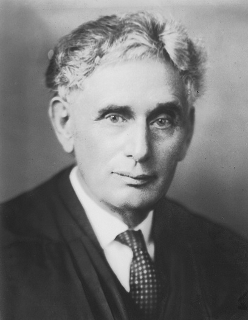
Louis Brandeis
Title: Justice Louis Dembitz Brandeis
Full Name: Louis Dembitz Brandeis
Birthdate: November 13, 1856
Birthplace: Louisville, Kentucky, USA
Date of Death: October 5, 1941
Occupation: Author and Judge
Profile: U.S. Supreme Court Justice (1916–1939).
Website: http://www.brandeis.edu/legacyfund/bio.html
Number of Quotes: 42
A man's private affairs are his own.
America has believed that in differentiation, not in uniformity, lies the path of progress.
An appeal to fear never finds an echo in American hearts.
As a rule, the most dangerous man to any government is the man who is able to think things out for himself.
Behind every argument is someone's ignorance.
Crime is contagious.
Decency, security, and liberty alike demand that government officials shall be subjected to the same rules of conduct that are commands to the citizen.
Democracy is a process of education.
Democracy rests on two pillars: one, the principle that all men are equally entitled to life, liberty and the
pursuit of happiness; and the other, the conviction that such equal opportunity will most advance civilization.
Do not put such unlimited power into the hands of the husbands. Remember all men would be tyrants if they could.
From his brief in Muller v. Oregon, quoting Abigail Adams.
Electric light the most efficient policeman.
Experience should teach us to be most on our guard to protect liberty when the government's purposes are beneficent.
Exposure is the remedy.
Fear of serious injury alone cannot justify oppression of free speech and assembly.
Government is the potent, the omnipresent teacher. For good or for ill, it teaches the whole people by its example.
If we desire respect for the law, we must first make the law respectable.
If you would only recognize that life is hard, things would be so much easier for you.
In the frank expression of conflicting opinions lies the greatest promise of wisdom in governmental action.
It is one of the happy incidents of the federal system that a single courageous state may, if its citizens choose,
serve as a laboratory; and try novel social and economic experiments without risk to the rest of the country.
From his dissent in New State Ice Co. v. Liebmann.
Knowledge is essential to understanding; and understanding should precede judging.
Light is the only disinfectant.
Men feared witches and burnt women.
Most of the things worth doing in the world had been declared impossible before they were done.
Necessity is the plea for every infringement of human freedom. It is the argument of tyrants; it is the creed of slaves.
Often cited; similar to a line from William Pitt the Younger,
which Brandeis invoked.
Nine-tenths of the serious controversies which arise in life result from
misunderstanding...result from one man not knowing the facts which to the other man seem important.
Our government is the potent, the omnipresent teacher.
Public discussion is a political duty.
Publicity is justly commended as a remedy for social and industrial diseases.
Responsibility is the great developer.
Sunlight is said to be the best of disinfectants.
The airplane, the radio, and the high-pressure salesman have made the world one neighborhood.
The Brandeis Brief.
Not a quote, but the name given to his innovative legal method using social and economic data.
The doctrine of the separation of powers was adopted by the Convention of 1787, not to promote efficiency but to preclude the exercise of arbitrary power.
From his dissent in Myers v. United States.
The greatest dangers to liberty lurk in insidious encroachment by men of zeal, well-meaning but without understanding.
The history of liberty is largely the history of the observance of procedural safeguards.
The most important political office is that of the private citizen.
The right to be let alone is the most comprehensive of rights and the right most valued by civilized men.
From his dissent in Olmstead v. United States.
There is in most Americans some spark of idealism, which can be fanned into a flame.
Those who won our independence believed liberty to be the secret of happiness and courage to be the secret of liberty.
To courageous, self-reliant men, with confidence in the power of free and fearless reasoning, no danger flowing from speech can be deemed clear and present.
We can have democracy in this country, or we can have great wealth concentrated in the hands of a few, but we can't have both.
A widely attributed summation of his views, though the exact phrasing is likely paraphrased.
When a nation is great, its citizens must trust it; and to trust it, they must know it.

 Last on Earth