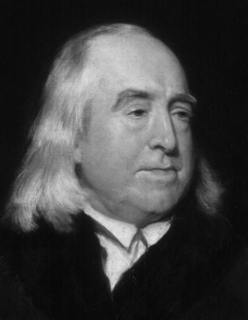
Jeremy Bentham
Birthdate: February 15, 1748
Birthplace: Spitalfields, London, England, United Kingdom
Date of Death: June 6, 1832
Occupation: Economist, Jurist, Philosopher, and Social Reformer
Profile: Founder of Utilitarianism.
Website: http://www.ucl.ac.uk/bentham-project
Number of Quotes: 32
All punishment is mischief; all punishment in itself is evil.
An action then may be said to be conformable to the principle of utility... when the tendency
it has to augment the happiness of the community is greater than any it has to diminish it.
An Introduction to the Principles of Morals and Legislation (1789)
As to the evil which results from a censorship, it is impossible to measure it, for it is impossible to tell where it ends.
But after all, what is a law? ... The law is not made by judge alone, but by judge and company.
Comment on the Commentaries (1776) Full Title: A Fragment on Government; being an Examination of What is
delivered on the Subject of Government in General, in the Introduction to Sir William Blackstone's Commentaries
Create all the happiness you are able to create; remove all the misery you are able to remove.
Every law is an infraction of liberty.
Principles of the Civil Code (1840)
He who thinks and thinks for himself, will always have a claim to thanks; it is no matter whether it be right or
wrong, so as it be explicit. If it is right, it will serve as a guide to direct; if wrong, as a beacon to warn.
It is the greatest good to the greatest number of people which is the measure of right and wrong.
Common paraphrase/summary of his principle.
It is vain to talk of the interest of the community, without understanding what is the interest of the individual.
Justice is in itself a part of utility, and is indeed the chief part.
Rationale of Judicial Evidence, Specially Applied to English Practice (1827)
Lawyers are the only persons in whom ignorance of the law is not punished.
Natural rights is simple nonsense: natural and imprescriptible rights, rhetorical nonsense — nonsense upon stilts.
Anarchical Fallacies (1843)
Nature has placed mankind under the governance of two sovereign masters, pain and pleasure. It
is for them alone to point out what we ought to do, as well as to determine what we shall do.
No power of government ought to be employed in the endeavor to establish any system or article of belief on the subject of religion.
Pain and pleasure are the sovereign masters governing man's conduct.
Paraphrase of the opening of An Introduction to the Principles of Morals and Legislation (1789).
Prejudice apart, the game of push-pin is of equal value with the arts and sciences of music and poetry.
The Rationale of Reward (1825)
Property is nothing but a basis of expectation.
Principles of the Civil Code (1840)
Secrecy, being an instrument of conspiracy, ought never to be the system of a regular government.
Stretching his hand up to reach the stars, too often man forgets the flowers at his feet.
The age we live in is a busy age; in which knowledge is rapidly advancing towards perfection.
The day may come when the rest of the animal creation may acquire those rights which never could have been withholden from them but by the hand of tyranny.
An Introduction to the Principles of Morals and Legislation - Note XVII (1789)
The greatest happiness of the greatest number is the foundation of morals and legislation.
The principle of asceticism never was, nor ever can be, consistently pursued by any living creature. Let but one tenth
part of the inhabitants of the earth pursue it consistently, and in a day's time they will have turned it into a Hell.
The question is not, Can they reason?
nor, Can they talk?
but rather, Can they suffer?
An Introduction to the Principles of Morals and Legislation - Note XVII (1789). Referring to animals and their moral consideration.
The said truth is that it is the greatest happiness of the greatest number that is the measure of right and wrong.
Tyranny and anarchy are never far apart.
The power of the lawyer is in the uncertainty of the law.
The utility of all these arts and sciences, ... I say, the value which they possess, is exactly in proportion to the pleasure they yield.
The Rationale of Reward (1825)
To what shall the character of utility be ascribed, if not to that which is a source of pleasure?
An Introduction to the Principles of Morals and Legislation (1789)
Utility is the foundation of justice.
Principles of the Civil Code (1840)
Utility when accurately considered is the source and test of law and justice.
Common paraphrase of his core principle.
War is mischief upon the largest scale.
Principles of International Law (1843)

 Last on Earth