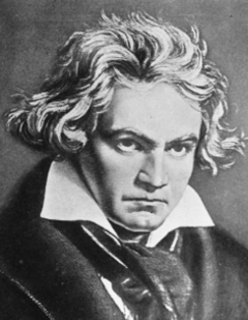
Ludwig van Beethoven
Birthdate: December 17, 1770
Birthplace: Bonn, Germany
Date of Death: March 26, 1827
Occupation: Composer and Pianist
Profile: Regarded as the greatest and most influential composer in music history.
Website: http://www.lvbeethoven.com/Bio/BiographyLudwig.html
Number of Quotes: 28
A great poet is the most precious jewel of a nation.
Diaries and conversation books (1810s–1820s).
A true artist is expected to be all that is noble-minded, and this is not altogether a
mistake; on the other hand, however, in what a mean way are critics allowed to pounce upon us.
Letter to Franz Gerhard Wegeler (November 16, 1801).
Applaud, friends, the comedy is over.
Last words (March 26, 1827).
Don't only practice your art, but force your way into its secrets; art deserves that, for it and knowledge can raise man to the Divine.
Letter to Emilie M. (often identified as Emilie von Reichenbach) (July 17, 1812).
I carry my thoughts within me long... before writing them down.
Letter to Louis Schlosser (1823). On his compositional process.
I joyfully hasten to meet death. If it come before I have had opportunity to develop all my artistic faculties, it will come, my hard fate
notwithstanding, too soon, and I should probably wish it later - yet even then I shall be happy, for will it not deliver me from a state of endless suffering?
Letter to Franz Gerhard Wegeler (November 16, 1801).
I must confess that I lead a miserable life. For almost two years, I have ceased to attend any social functions, just because I find it impossible to say
to people, I am deaf.
If I had any other profession, I might be able to cope with my infirmity; but in my profession, it is a terrible handicap.
Heiligenstadt Testament (1802).
I only live in my music, and I have scarcely begun one thing when I start on another.
As I am now working, I am often engaged on three or four things at the same time.
Letter to Franz Gerhard Wegeler (November 16, 1801).
I will seize fate by the throat...
Letter to Franz Gerhard Wegeler (November 16, 1801).
I will seize fate by the throat; it shall not bend or crush me completely.
Written as deafness worsened.
Music is a higher revelation than all wisdom and philosophy. Music is the electrical soil in which the spirit lives, thinks and invents.
Letter to Bettina von Arnim (née Brentano) (1810).
Music is indeed the mediator between the spiritual and the sensual life.
Letter to Bettina von Arnim (née Brentano) (1810).
Music is the mediator between the spiritual and the sensual life... a higher revelation than all wisdom and philosophy.
Letter to Bettina von Arnim (née Brentano) (1810).
Music is the one incorporeal entrance into the higher world of knowledge which comprehends mankind but which mankind cannot comprehend.
Letter to Bettina von Arnim (née Brentano) (1810).
Never to break one's word is the royal road to Heaven.
Notebook entry (1823). Emphasizing integrity.
O, you men who think or say that I am malevolent, stubborn or misanthropic, how greatly do you wrong me. You do
not know the secret cause which makes me seem that way to you, and I would have ended my life - it was only my art that
held me back. Ah, it seemed impossible to leave the world until I had brought forth all that I felt was within me.
Heiligenstadt Testament (1802).
Often, I can scarcely hear any one speaking to me; the tones yes, but not the actual words; yet
as soon as any one shouts, it is unbearable. What will come of all this, heaven only knows!
Letter to Franz Gerhard Wegeler (November 16, 1801).
Only the pure in heart can make a good soup.
Conversation book (1820). A humorous remark to his friend Karl Holz.
Recommend virtue to your children; it alone, not money, can make them happy. I speak from experience.
Letter to his nephew Karl (1816). From a series of moral admonitions.
The true artist is not proud: he unfortunately sees that art has no limits; he feels darkly how far he is from the goal, and though he
may be admired by others, he is sad not to have reached that point to which his better genius only appears as a distant, guiding sun.
Heiligenstadt Testament (1802).
The world is a king... true art is selfish and perverse.
Letter to Franz Brentano (February 10, 1811).
There ought to be an artistic depot where the artist need only hand in his artwork in order to receive what he asks for. As
things are, one must be half a business man, and how can one understand - good heavens! - that's what I really call troublesome.
Letter to Franz Brentano (March, 1822).
This is the mark of a really admirable man: steadfastness in the face of trouble.
Letter to Archduke Rudolph (1815). On resilience.
Tones sound, and roar and storm about me until I have set them down in notes.
Heiligenstadt Testament (1802).
What you are, you are by accident of birth; what I am, I am by myself.
To Prince Lichnowsky (1806). Asserting self-made genius over aristocratic privilege.
What I have in my heart and soul - must find a way out. That's the reason for music.
Conversation with Louis Schlösser (1822).
What you are, you are by accident of birth; what I am, I am by myself. There are and will be a thousand princes; there
is only one Beethoven.
When somewhat at a distance, I cannot hear the high tones of instruments, voices. In speaking, it is not surprising
that there are people who have never noticed it, for as a rule I am absent-minded, and they account for it in that way.
Letter to Karl Amenda (July 1, 1801).

 Last on Earth